

FACTS & FIGURES

icon-organization

Organization overview

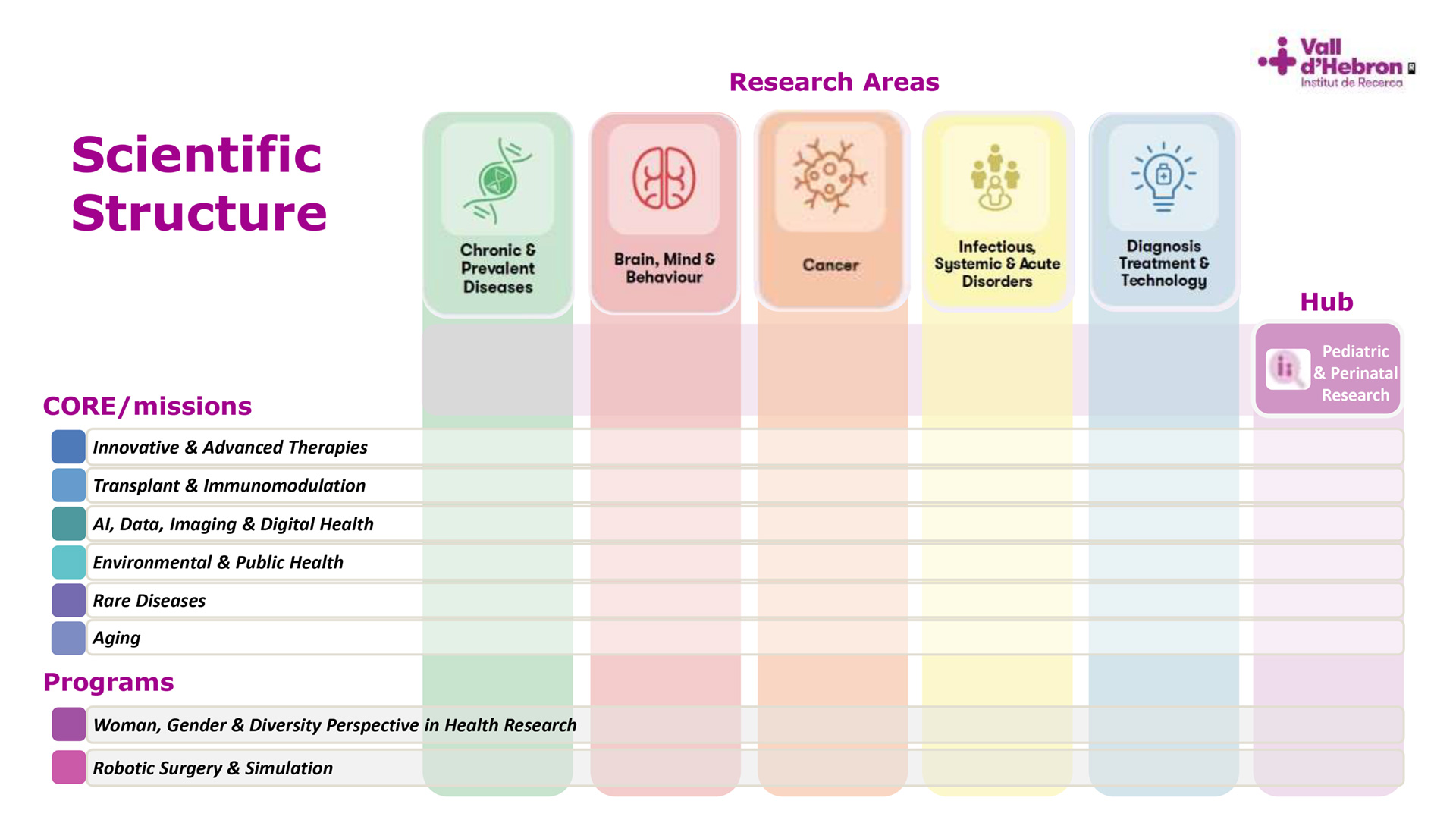
Over the course of 2025, the new VHIR Scientific Structure has been progressively consolidated. Designed to promote clinical and translational research, innovation, and knowledge transfer with a direct impact on people’s health, it was presented to the Scientific Advisory Board (SAB) in September 2025 and to the Clinical and Clinical Innovation Committee (CCI) in November 2025, before receiving final approval from the Board of Trustees in December 2025.

The Research Areas are the structural axis of VHIR and group together the 63 research groups into specialized fields of knowledge, aligned with the clinical and strategic priorities of Vall d’Hebron University Hospital. Each research group has a single and mandatory affiliation to one Area, which enables a more efficient organization, a clear identification of scientific expertise, and the generation of internal and external synergies to provide a coordinated response to the main health challenges.

More information about the areas and the groups activity:

The Pediatric and Perinatal Research Hub integrates research covering from the prenatal period to adolescence, ensuring the transition to adulthood, with the aim of promoting, developing and transferring research to improve the health and quality of life of children and adolescents, positioning VHIR as a global reference in this field and creating impact on patients and society.

More information about the Pediatric and Perinatal Research Hub:

The COREs (Collaborative Research Strategic Spaces) are transversal and flexible research spaces, oriented towards priority or emerging topics and aligned with the institutional strategy and the missions of the European Commission. Their function is to drive VHIR’s strategic development by generating and guiding new high-impact scientific opportunities that strengthen the institution’s competitiveness.

Discover the top publications of each CORE:

The Programmes promote interdisciplinary interaction in transversal fields, such as research with a gender and diversity perspective or the use of robotic surgery and simulation, integrating professionals from different disciplines to incorporate these key dimensions into VHIR’s scientific and teaching activity.

More information about the Programmes:

For the Hub, COREs and Programmes, participation is voluntary, open and without limit of adhesions for all Principal Investigators from the five Research Areas, with the aim of promoting collaborative research.

The Research Areas will have a Scientific Lead and a Deputy, while each CORE will have two Scientific Coordinators with alternating participation in the CCI and, preferably, complementary profiles. The Programmes will have a specific Coordinator. All these roles will be supported transversally by the Scientific Coordination Unit for their operation and strategic deployment.

  • VHIR has 19 research groups recognised by CIBER across 11 of its 13 thematic areas.
  • VHIR participates in 20 of the 24 European Reference Networks (ERNs) established at the European level.
  • VHIR has 50 Centres, Services and Reference Units (CSURs) recognised by the Spanish Ministry of Health, covering a total of 87 diseases or procedures.
  • VHIR participates in 4 of the 11 R&D&I Networks funded by AGAUR between 2022 and 2025.
  • VHIR participates in 4 of the 7 RICORS networks funded by ISCIII between 2022 and 2025.
  • VHIR participates in 5 Research Networks funded by the Spanish State Research Agency (AEI).